Best Backyard Shade Ideas: 12 Smart Ways To Keep Your Yard Cooler Fast
When summer sun turns your patio into a place you avoid, adding shade can make a bigger difference than buying another fan or constantly retreating indoors. The best backyard shade ideas block direct sunlight where it matters most—over seating, dining areas, play spaces, and heat-absorbing patios—without making your yard feel dark or closed in.
Better yet, you don’t necessarily need an expensive covered patio. A well-positioned umbrella can transform a small seating area in minutes. Shade sails can cover larger spaces, while pergolas, retractable awnings, and strategically planted trees offer longer-term solutions.
The smartest approach is to match the shade solution to your budget, climate, wind exposure, and the way you actually use your backyard. Start with the hottest, most-used area rather than trying to shade everything.
With a few practical changes, you can create a cooler, more comfortable outdoor space without wasting money on improvements you don’t need.
☀️ Quick Answer: Best Backyard Shade Ideas
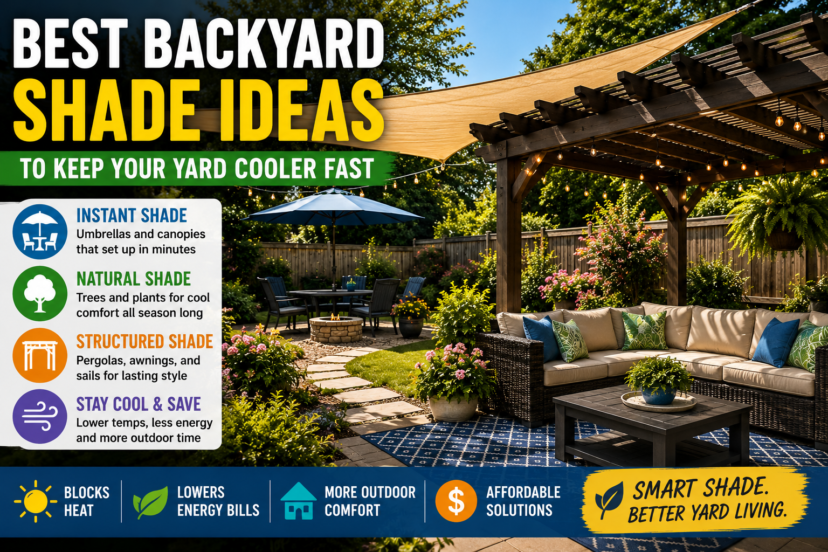
The best backyard shade ideas include patio umbrellas for fast, affordable coverage; shade sails for larger open areas; retractable awnings for flexible house-side shade; pergolas for permanent outdoor living spaces; and trees for natural long-term cooling. For the fastest results, shade the areas where people sit rather than the entire yard. Focus especially on blocking intense afternoon and western sun while keeping the sides open for airflow.
Key Takeaways
- Most likely cause: An uncomfortable backyard usually has too much direct sun over patios, furniture, play areas, or other frequently used spaces.
- Usually serious? No, but excessive heat can make outdoor areas difficult to use and can create dangerously hot surfaces during extreme weather.
- First thing to check: Observe where the strongest sunlight falls between noon and early evening, especially during summer.
- Best solution: The best backyard shade ideas target high-use areas first with umbrellas, sails, awnings, pergolas, or properly positioned trees.
🌡️ Why Shade Makes Such A Big Difference
Air temperature is only part of what makes a backyard feel hot.
Direct solar radiation heats your skin, outdoor furniture, decking, concrete, brick, stone, and other surfaces. Those surfaces can then release stored heat into the surrounding area.
Blocking direct sunlight can therefore improve comfort even though you’re not actually changing the outdoor air temperature.
Shade can also help protect:
- Patio furniture
- Outdoor cushions
- Deck surfaces
- Children’s play equipment
- Container plants
- Outdoor dining spaces
In hot U.S. regions such as Arizona, Nevada, Texas, and Southern California, afternoon shade can be especially valuable. Humid climates also benefit because combining shade with good airflow can make outdoor seating much more comfortable.
The trick is creating shade without completely blocking the breeze.
🌳 12 Best Backyard Shade Ideas For A Cooler Outdoor Space
1. Add A Large Patio Umbrella
A patio umbrella is one of the fastest and easiest backyard shade solutions.
There’s little construction involved, and you can reposition many umbrellas as the sun moves.
Traditional market umbrellas work well over dining tables, while cantilever umbrellas are useful over conversation areas because the support pole sits to the side.
Look for:
- A sturdy base
- Outdoor-rated fabric
- UV-resistant materials
- Adjustable tilt
- Appropriate coverage
- Easy opening and closing
Measure your seating area before purchasing. A small umbrella over a large sectional won’t provide much relief.
Always close umbrellas when weather or wind conditions exceed manufacturer recommendations.
2. Install A Shade Sail
Shade sails can cover surprisingly large spaces without the expense of constructing a full roof.
They’re particularly useful over patios, children’s play areas, poolsides, and open seating zones.
The key is proper installation.
Shade sails can experience substantial wind loads, so attachment points must be structurally appropriate. Don’t simply screw a large sail into a fence board, fascia, or decorative post.
Some homeowners use multiple overlapping sails to create broader coverage and an attractive layered appearance.
Because installation quality matters, larger systems may deserve professional planning.
3. Build A Pergola
Pergolas are among the best backyard shade ideas when you want to create a defined outdoor living space.
A traditional open-roof pergola provides partial shade while maintaining airflow. Additional shade can be created with appropriate fabric, adjustable louvers, or other roof systems.
Pergolas work especially well over:
- Outdoor dining areas
- Conversation spaces
- Outdoor kitchens
- Hot tubs
- Larger patios
They’re more expensive than umbrellas but can become a long-term architectural feature.
Before building, check permit, setback, HOA, wind-load, and structural requirements.
4. Use A Retractable Awning
Retractable awnings provide shade when you need it and sunlight when you don’t.
They can be especially effective over patios or decks located directly beside the house.
On a hot afternoon, extend the awning to shade the seating area. During cooler weather, retract it to allow additional sunlight.
Motorized versions add convenience, while manual systems may cost less and require fewer electrical components.
Because an awning attaches to your home, proper mounting is important. Larger installations are often better handled professionally.
5. Plant A Strategic Shade Tree
Trees don’t provide instant results, but they can become one of the most valuable long-term shade solutions.
A properly positioned deciduous tree can shade a patio during summer while allowing more sunlight through during winter after its leaves fall.
Choose trees according to:
- USDA Plant Hardiness Zone
- Local climate
- Soil conditions
- Water availability
- Mature canopy size
- Mature height
- Root characteristics
- Storm exposure
Don’t plant a tree based only on its size at the nursery.
Think about what it could look like in 10, 20, or 30 years and keep appropriate distances from structures and utilities.
6. Create Shade With A Cantilever Umbrella
Although technically another type of umbrella, cantilever designs deserve special attention.
Because the support pole sits outside the shaded area, they work particularly well with sofas, lounge chairs, and irregular furniture arrangements.
Some models can rotate or tilt, allowing you to adjust coverage as the sun changes position.
They’re an excellent option for homeowners who want substantial shade but aren’t ready to build a permanent structure.
Use the base or anchoring system specified by the manufacturer. A large canopy can catch significant wind.
7. Add A Retractable Pergola Canopy
Already have a pergola that doesn’t provide enough shade?
You may not need to replace it.
A retractable outdoor canopy can provide more complete overhead coverage while preserving the existing structure.
This gives you flexibility: close the canopy during intense afternoon sun and open it when you want additional light.
Make sure any canopy system is compatible with the pergola and rated for outdoor conditions.
Water drainage and wind resistance also need to be considered.
8. Use Outdoor Curtains Strategically
Overhead shade solves most midday sun problems, but low-angle afternoon sunlight can still enter from the side.
Outdoor curtains can provide temporary protection around covered patios, pergolas, and gazebos.
The important word is temporary.
You generally don’t want every side permanently closed because that can restrict airflow.
Use curtains selectively on the side receiving intense low-angle sun, then open them when they’re not needed.
Choose outdoor-rated fabrics and secure them appropriately in breezy conditions.
9. Grow Vines Over A Suitable Structure
Climbing plants can add shade and greenery to a pergola or trellis.
Depending on your climate, possibilities may include appropriate varieties of:
- Grapes
- Jasmine
- Clematis
- Honeysuckle
- Other regionally suitable vines
Check local recommendations before planting because some climbing plants can become invasive or overly aggressive.
Also consider maintenance.
Living shade needs pruning, irrigation, and cleanup. It can be beautiful, but it’s not maintenance-free.
Make sure the supporting structure is appropriate for the mature weight of the plant.
10. Add A Pop-Up Canopy For Flexible Shade
You don’t always need a permanent backyard solution.
A pop-up canopy can provide temporary shade for:
- Parties
- Children’s activities
- Outdoor projects
- Picnics
- Seasonal gatherings
This is particularly useful for homeowners who only occasionally need to shade a large section of lawn.
Always anchor the canopy according to manufacturer instructions, and don’t leave temporary structures outside during unsafe weather.
For occasional use, this can be far cheaper than constructing permanent shade.
11. Use Landscaping To Shade Hardscape
Sometimes you don’t need to shade people directly. Reducing sunlight on surrounding surfaces can also improve the feel of an outdoor space.
Planting beds, trees, and shrubs can break up large expanses of exposed concrete, stone, or pavers.
Container plants can also soften patios where permanent landscaping isn’t possible.
Don’t overcrowd the seating area, though.
Dense vegetation surrounding every side of a patio can restrict airflow. Aim for a balance between greenery, shade, and open space.
12. Combine Several Types Of Shade
One solution doesn’t have to do everything.
Some of the best backyard shade ideas use several smaller strategies together.
For example:
- A tree shades the western side of the patio.
- A pergola protects the main dining area.
- An umbrella covers a separate lounge space.
- An outdoor curtain blocks late-afternoon glare.
Layering shade gives you more control as sunlight changes throughout the day and year.
It also allows you to improve the backyard gradually instead of paying for one enormous project.
🧭 Find The Hottest Part Of Your Yard Before Spending Money
Before buying anything, perform a simple sun audit.
Observe your backyard around:
- 9 a.m.
- Noon
- 3 p.m.
- 6 p.m.
Do this during warm weather when backyard comfort matters most.
Pay attention to where people actually sit.
A patio may receive comfortable morning shade but become intensely sunny at 4 p.m.—exactly when your family wants to use it.
Also notice reflected and stored heat from walls, fences, concrete, brick, and other hard surfaces.
You may discover that moving your dining table six feet solves part of the problem for free.
💰 Best Backyard Shade Ideas On A Budget
If you want maximum comfort without overspending, make improvements in stages.
Start with:
- Use Existing Shade: Rearrange furniture under trees or structural shade.
- Add An Umbrella: Create immediate coverage over your highest-use area.
- Use Temporary Shade: Consider a canopy for occasional activities.
- Plant For The Future: Add a suitable shade tree if space allows.
- Upgrade Later: Consider a pergola or awning after you know exactly where permanent shade is needed.
This prevents one of the most common backyard mistakes: investing heavily before understanding how sunlight moves across the property.
🌬️ Don’t Sacrifice Airflow For Shade
A shaded patio can still feel uncomfortable when there’s no air movement.
Whenever practical, create shade overhead rather than enclosing the entire seating area with solid walls.
Umbrellas, pergolas, tree canopies, and shade sails can block solar exposure while leaving the sides open.
If natural airflow is limited, an appropriately rated outdoor fan can supplement it.
Shade plus airflow is usually a more effective comfort strategy than either one alone.
🌿 Natural Shade Vs. Built Shade
Both approaches have advantages.
Natural shade from trees can look beautiful, support landscaping, and provide long-term coverage. However, trees take time to mature and require maintenance.
Built shade provides faster and more predictable coverage. Umbrellas may work immediately, while pergolas and awnings can create dependable shade exactly where it’s needed.
Many backyards benefit from combining both.
Use built shade for immediate comfort while planting strategically for the future.
🏡 Can Backyard Shade Help Keep Your House Cooler?
Strategic exterior shade can reduce direct sunlight on certain windows and walls, which may help reduce solar heat gain.
However, results depend heavily on climate, orientation, building design, insulation, windows, and the location of the shade.
Don’t plant large trees too close to a house simply for cooling.
Consider mature roots, branches, storm risks, gutters, roof clearance, and local wildfire concerns where applicable.
A landscape designer or certified arborist can help plan long-term tree placement around a home.
👷 When To Consult A Professional
Portable umbrellas and small temporary shade solutions are usually straightforward DIY projects.
Consider professional help for permanent pergolas, large shade sails, retractable awnings, structural attachments to your house, large tree planting, electrical work, or projects requiring substantial footings.
A contractor, landscape professional, or arborist can also help determine whether your proposed shade solution is appropriate for local wind, snow, soil, and weather conditions.
Check building codes, permits, property setbacks, HOA rules, and utility locations before beginning permanent work.
❓ FAQs About Best Backyard Shade Ideas
What Is The Cheapest Way To Shade A Backyard?
Using existing shade costs nothing, while a patio umbrella is often one of the most affordable ways to create useful targeted shade. Temporary canopies can also provide economical coverage for occasional activities.
What Is The Best Way To Shade A Large Backyard?
Instead of trying to cover the entire yard, shade individual activity zones. Trees, large shade sails, pergolas, and strategically placed umbrellas can create comfortable areas while keeping other sections open.
How Can I Shade My Patio Without Building A Roof?
Consider patio umbrellas, shade sails, retractable awnings, pergolas with shade fabric, or appropriately positioned trees. These can provide substantial coverage without constructing a conventional solid roof.
Are Shade Sails Good For Backyards?
Yes, when correctly designed and installed. Shade sails can provide broad coverage with relatively few supports, but they require strong attachment points and appropriate tension because they can experience substantial wind loads.
What Is Better, A Pergola Or An Umbrella?
An umbrella is less expensive, movable, and easier to install. A pergola is a more permanent structure that can define an outdoor living area and support additional shade features. The best choice depends on budget and how frequently you use the space.
What Trees Are Best For Backyard Shade?
The best species depends on your climate, soil, available space, water availability, and USDA Plant Hardiness Zone. Look for a healthy, regionally appropriate tree with a mature canopy suitable for the location.
How Do I Shade My Backyard Without Blocking Airflow?
Focus on overhead shade. Tree canopies, umbrellas, pergolas, and appropriately designed shade sails can block direct sunlight while keeping the sides of the seating area relatively open to breezes.
🎯 Conclusion: Best Backyard Shade Ideas
The best backyard shade ideas aren’t necessarily the biggest or most expensive.
They’re the solutions that put shade exactly where you need it, at the time of day you actually use your yard.
Start by observing the sun. Identify your hottest seating or dining area and test the simplest solution first. Move the furniture into existing shade, add an umbrella, or use temporary coverage before committing to permanent construction.
If you need something more substantial, a shade sail, awning, pergola, or carefully positioned tree can provide a longer-term answer.
And remember that comfort isn’t only about shade. Keep useful airflow moving through the space rather than enclosing your patio on every side.
You don’t need to transform your entire property to make summer more enjoyable. Shade one important area well, then improve the backyard gradually as your needs and budget allow.
That’s better yard living: practical improvements that make your outdoor space cooler, easier to use, and more enjoyable without spending more than necessary.
Disclaimer: This article provides general landscaping and outdoor-living information. Local climate, wind loads, building codes, permits, HOA rules, utility locations, and structural requirements vary. Follow manufacturer instructions and consult qualified professionals for permanent structures, electrical work, major tree work, or installations beyond your DIY experience.
 Explore more:
- How To Stop Backyard Mud: 11 Smart Ways
- Energy Efficient Backyard: 12 Smart Ways
- Standing Water Near House Foundation?