Standing Water Near House Foundation? 10 Common Causes And Smart Ways To Fix It
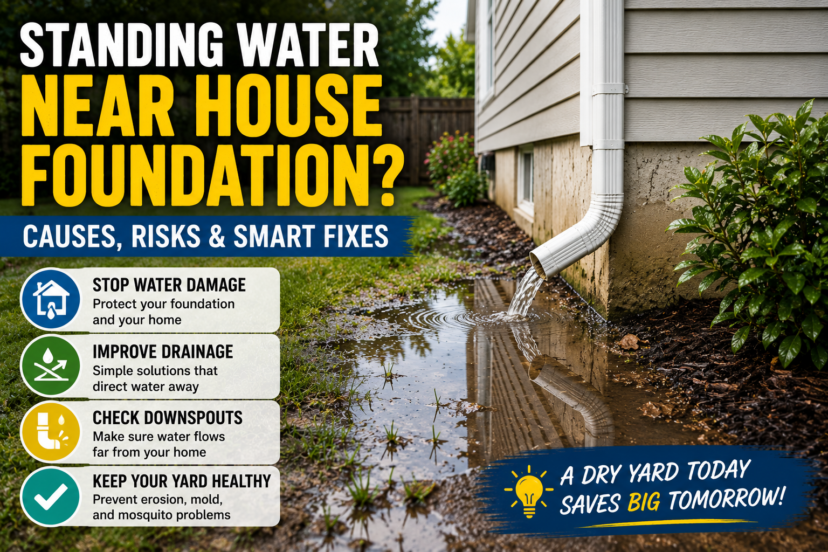
A puddle beside your home after a heavy storm may not look like a major problem, but it’s worth paying attention to—especially when it keeps returning. Standing water near house foundation areas can mean rainwater isn’t draining away from the property as efficiently as it should. The cause could be something simple, such as a clogged gutter or short downspout, or a larger issue involving grading, compacted soil, drainage systems, or runoff from surrounding areas.
The good news is that homeowners can identify many drainage problems before they turn into expensive repairs. Start by watching what happens during rainfall rather than immediately buying drainage equipment.
Where does roof water go? Does the ground slope toward or away from the house? How long do puddles remain?
Answering those questions can help you make smarter improvements that protect your landscaping, reduce muddy areas, and keep unnecessary water away from your foundation.
💧 Quick Answer: Standing Water Near House Foundation
Standing water near house foundation areas is commonly caused by poor grading, clogged gutters, downspouts discharging too close to the home, compacted soil, low spots, or inadequate yard drainage. Start by checking gutters and downspouts and watching where rainwater travels during a storm. The soil immediately around a house should generally direct surface water away from the foundation. Persistent pooling, foundation movement, or basement/crawl-space moisture deserves professional evaluation.
Key Takeaways
- Most likely cause: Poor grading, short or poorly directed downspouts, clogged gutters, compacted soil, or low areas that collect runoff.
- Usually serious? Not always, but repeated water accumulation beside a foundation should not be ignored because it can contribute to moisture and drainage problems.
- First thing to check: Inspect gutters, downspouts, and the direction the ground slopes around the house during or immediately after rainfall.
- Best solution: If you have standing water near house foundation areas, correct the source of the runoff and direct water safely away rather than simply filling the puddle.
🏡 Why Water Collects Around A House Foundation
Water naturally moves downhill and collects in low areas. Your yard should therefore work as part of the home’s drainage system.
When rain lands on the roof, gutters collect a large amount of runoff and direct it into downspouts. From there, the water needs somewhere safe to go.
At the same time, rainfall hitting lawns, patios, driveways, and neighboring areas moves across or into the soil.
Problems occur when this water is directed toward the house faster than the soil or drainage system can handle it.
Repeated pooling may lead to:
- Soggy landscaping
- Soil erosion
- Muddy areas
- Excess moisture around foundation walls
- Damp crawl spaces or basements
- Mosquito breeding opportunities
- Landscape damage
The correct solution depends on where the water is coming from.
🔍 10 Common Causes Of Standing Water Near The Foundation
1. The Ground Slopes Toward Your House
Poor grading is one of the first things to investigate.
If the surrounding soil slopes toward the foundation, rainwater naturally follows that slope and collects beside the house.
This sometimes develops gradually. Soil can settle after construction, landscaping can change the original grade, and garden beds may be installed incorrectly.
How To Check: During rainfall, observe whether surface runoff travels toward or away from the foundation.
How To Fix: Minor grading issues may be corrected by properly reshaping the soil so water moves away from the structure. Major grading problems should be evaluated professionally, especially if changing the grade could affect neighboring properties.
2. Your Downspouts End Too Close To The Foundation
Your roof can collect hundreds of gallons of water during a substantial storm.
If a downspout releases all that water directly beside the house, the soil may become saturated quickly.
Check each downspout after rainfall.
Water should discharge in a location where it can continue moving safely away without creating erosion, ice hazards, or problems for neighboring properties.
Downspout extensions can sometimes provide a simple solution.
Avoid creating trip hazards or directing water onto sidewalks, driveways, or adjacent properties.
3. Your Gutters Are Clogged
Leaves, pine needles, roof debris, and other material can block gutters.
When that happens, rainwater may overflow instead of reaching the downspouts.
Watch your gutters during moderate rain.
If water is pouring over the edge, you may have a blockage, inadequate slope, damaged gutter, or another drainage problem.
Cleaning gutters can be straightforward, but ladder work carries serious fall risks. Hire a professional if you cannot safely access them.
4. There Is A Low Spot Beside The House
Sometimes standing water near house foundation areas comes from one small depression rather than a whole-yard drainage problem.
Soil may settle near a downspout, utility trench, garden bed, or recently disturbed area.
A depression only a few inches deep can capture runoff.
Correcting the low spot may be relatively simple, but don’t just dump soil into the puddle without understanding where the water will go afterward.
The goal is to redirect runoff safely—not move the puddle several feet away.
5. Your Soil Drains Very Slowly
Soil type plays a major role in yard drainage.
Clay-heavy soils can absorb water slowly, especially when already saturated. Compacted soils may also have poor infiltration.
If water collects throughout your property rather than only beside the foundation, soil conditions may be contributing to the problem.
Avoid automatically adding sand to clay soil. Mixing the wrong proportions can create undesirable soil conditions rather than improving drainage.
For persistent problems, a soil test or professional drainage evaluation can help determine the right approach.
6. Your Lawn Or Garden Has Become Compacted
Repeated foot traffic, construction equipment, vehicles, and even years of normal use can compress soil.
Compaction reduces pore space, which can limit how quickly water enters the ground.
Signs may include:
- Hard soil
- Sparse grass
- Surface runoff
- Water pooling after rain
- Difficulty pushing a screwdriver or soil probe into the ground
Core aeration can help some compacted lawn areas, but it won’t solve poor grading or major drainage problems.
Identify the actual cause before renting equipment.
7. A Patio Or Walkway Directs Water Toward The House
Hard surfaces change how water moves.
A concrete patio, paver walkway, driveway, or other impermeable surface may shed runoff toward the foundation if its slope is incorrect.
This can become particularly noticeable during heavy thunderstorms.
Watch the edges of the hardscape during rain.
If runoff consistently flows toward the house, the solution may involve drainage channels, regrading, or modifying the hardscape.
Larger corrections often require professional help.
8. An Underground Drain Is Clogged Or Damaged
Some homes use buried downspout lines, French drains, catch basins, or other underground drainage systems.
These systems can become clogged with:
- Leaves
- Soil
- Roots
- Sediment
- Debris
Pipes can also become crushed, separated, or incorrectly pitched.
If your downspout disappears underground and water suddenly backs up near the foundation, the buried line deserves investigation.
Don’t assume the pipe is working simply because you can’t see it.
9. Landscape Beds Are Trapping Water
Raised landscape edging can unintentionally create a shallow basin beside the house.
Decorative borders, tightly packed mulch, and incorrectly graded planting beds can prevent runoff from escaping.
Mulch itself isn’t necessarily the problem. The overall elevation and drainage path matter more.
Make sure landscape improvements haven’t created a dam that holds rainwater against the foundation.
Also avoid piling soil or mulch high against siding or other building materials.
10. Runoff Is Coming From Another Part Of The Property
The puddle beside your foundation may originate much farther away.
Water can travel downhill from:
- An upper lawn
- A driveway
- A neighbor’s property
- A retaining wall
- A slope
- A patio
- A drainage swale
This is why observation during rainfall is so useful.
Following the water upstream often reveals a different problem than you expected.
🛠️ How To Fix Standing Water Near House Foundation Areas
The smartest fix addresses the source.
Start with simple, low-cost problems before considering excavation or major drainage systems.
Step 1: Clean And Inspect The Gutters
Make sure roof runoff can move freely into downspouts.
Look for sagging sections, leaks, disconnected joints, and overflow.
Step 2: Check Every Downspout
Confirm that water isn’t being dumped directly beside the foundation.
A properly designed extension or drainage connection may move runoff to a more appropriate location.
Step 3: Check The Grade
Look for depressions or soil that slopes back toward the house.
Minor grading adjustments may be DIY-friendly, but larger changes should be planned carefully.
Step 4: Observe The Yard During Rain
This may be the most valuable step.
Safely observe where water enters the problem area, where it travels, and where it stops.
Take photos or videos for comparison or to show a contractor.
Step 5: Consider A Drainage System Only When Necessary
Depending on the property, a professional may recommend solutions such as:
- French drains
- Catch basins
- Channel drains
- Drainage swales
- Buried downspout extensions
- Regrading
Don’t install a French drain simply because water exists. Different drainage problems require different solutions.
🌧️ How Long Is Too Long For Water To Sit Near A Foundation?
A temporary puddle immediately after an intense storm doesn’t automatically indicate foundation damage.
What matters is how often the problem occurs, how much water accumulates, and how long the soil remains saturated.
Pay closer attention when water:
- Returns after ordinary rainfall
- Remains for extended periods
- Covers a large area
- Reaches foundation vents or openings
- Is accompanied by basement or crawl-space moisture
- Causes visible erosion
- Appears alongside foundation movement or cracking
Persistent drainage problems deserve more attention than occasional temporary pooling after unusually heavy rain.
🌿 Landscaping Without Creating Drainage Problems
A well-designed landscape should help manage water rather than trap it.
When creating beds near the house, maintain proper drainage patterns and avoid building up soil or mulch against the structure.
Use plants appropriate for local soil and moisture conditions, but don’t rely on plants alone to solve large amounts of foundation runoff.
Rain gardens can be useful for managing runoff in appropriate locations, but they should be carefully sited and designed. A rain garden is generally not something you want positioned directly against your foundation.
Local Cooperative Extension offices can provide useful regional guidance on soils, plants, and stormwater-friendly landscaping.
💰 Start With The Cheapest Fixes First
A drainage contractor may eventually be necessary, but don’t assume you immediately need an expensive system.
Start by checking:
- Clogged gutters
- Disconnected downspouts
- Short downspout discharge
- Small low spots
- Blocked surface drainage
- Landscape edging that traps water
These relatively simple issues can sometimes explain a surprisingly large drainage problem.
If they don’t, you’ll have better information before paying someone to evaluate the property.
⚠️ Why You Shouldn’t Ignore Repeated Foundation Pooling
Water itself isn’t automatically a foundation emergency.
However, consistently saturated soil beside the house can contribute to moisture problems and may interact with soil movement differently depending on local conditions and foundation type.
Homes built on expansive clay soils, for example, may respond differently to moisture changes than homes built on sandy soils.
That is why there is no universal DIY fix for every property.
Treat recurring standing water near house foundation areas as a drainage warning sign worth investigating rather than something to simply cover with mulch.
👷 When To Consult A Professional
Contact a drainage contractor, landscaper, foundation specialist, or qualified engineer when water continues pooling despite basic corrections, enters a basement or crawl space, causes significant erosion, or appears alongside foundation movement or substantial cracking.
Professional help is also recommended for major regrading, retaining walls, deep excavation, buried drainage systems, or projects that could redirect water toward neighboring properties.
Before digging, contact 811 as required to locate underground utilities. Also check local stormwater rules, building codes, HOA requirements, and drainage regulations.
❓ Frequently Asked Questions About Standing Water Near House Foundation
Is Standing Water Next To A House Foundation Bad?
Repeated standing water beside a foundation can be a concern because it keeps nearby soil wet and may contribute to moisture, erosion, or drainage problems. Occasional short-lived puddles after extreme storms are different from recurring pooling.
How Do I Stop Water From Pooling Around My Foundation?
Start by cleaning gutters, extending downspouts where appropriate, correcting low areas, and making sure surface water drains away from the home. Persistent problems may require professional grading or drainage improvements.
How Far Should Water Drain Away From A House?
There isn’t one distance that works for every property. The important goal is for runoff to move safely away from the foundation to an approved drainage location without returning toward the house or affecting neighboring property. Local requirements may provide specific guidance.
Will Gravel Around A Foundation Help Drainage?
Gravel alone does not correct poor grading or provide a destination for runoff. In some properly designed drainage systems, it can be useful, but simply covering a wet area with gravel may hide rather than solve the problem.
Will A French Drain Fix Water Around My Foundation?
A French drain can help in certain situations involving subsurface or surface water, but it isn’t the correct solution for every drainage problem. If the cause is a clogged gutter or poorly positioned downspout, fixing that source may be simpler and less expensive.
Can Standing Water Damage A Concrete Foundation?
Persistent water and saturated soil around a foundation can contribute to moisture-related problems and may interact with soil movement. The risk depends on the foundation, soil, drainage, climate, and severity of the problem.
Why Does Water Pool Near My House Only After Heavy Rain?
Heavy rain may exceed the soil’s infiltration capacity or overwhelm gutters and drainage systems. It can also reveal low spots that don’t become noticeable during lighter rainfall. Watching the yard during a storm can help identify the source.
🎯 Conclusion: Standing Water Near House Foundation
Finding standing water near house foundation areas doesn’t automatically mean you’re facing a major repair bill.
It does mean your yard is giving you useful information.
Start with the basics. Check your gutters. Watch the downspouts. Look at the slope of the soil. Find low spots. Then observe what happens during the next rainfall.
Often, the smartest drainage improvement isn’t the most expensive one—it’s the one that corrects the actual source of the water.
And if the problem turns out to require professional drainage work, identifying how the water moves across your property gives you a much better starting point.
A backyard that manages rain effectively is easier to maintain, less muddy, and more enjoyable. More importantly, good drainage helps protect the home at the center of your property.
That’s better yard living: understanding how your outdoor space works and making practical improvements before small problems become expensive ones.
Disclaimer: This article provides general yard drainage and home improvement information and is not a substitute for site-specific engineering or foundation advice. Drainage requirements, soils, building codes, stormwater regulations, and property conditions vary. Contact 811 before any applicable digging and consult qualified professionals for significant drainage, structural, excavation, or foundation concerns.
 Explore more:
- How To Keep Outdoor Furniture Cool
- Backyard Layout Ideas: 11 Smart Ways
- DIY Backyard Projects: 12 Easy Upgrades