Why Does My Backyard Stay Muddy After Rain? 10 Common Causes And Smart Fixes

A backyard should be a place where you can relax, grill, garden, or let the kids and pets play—not an obstacle course of puddles and mud. If you’re wondering why does my backyard stay muddy after rain, the answer usually comes down to slow-draining soil, compaction, poor grading, concentrated runoff, or simply too much water entering one area.
The frustrating part is that mud can remain long after the storm has passed. It sticks to shoes, gets tracked indoors, makes mowing difficult, damages grass, and keeps you from enjoying outdoor spaces you’ve already paid for.
Fortunately, a muddy yard doesn’t automatically mean you need an expensive French drain or a complete landscape renovation. Many drainage problems have simpler solutions.
The smartest approach is to identify where the water comes from, understand why it isn’t draining, and fix the easiest problems first. Here’s how to do exactly that.
💧 Quick Answer: Why Does My Backyard Stay Muddy After Rain?
If you’re asking why does my backyard stay muddy after rain, common causes include compacted soil, heavy clay, low spots, poor grading, roof runoff, excessive shade, overwatering, or blocked drainage. Start by watching your yard during a storm. Redirect obvious runoff, aerate compacted soil, improve soil with compost, and correct small depressions before investing in major drainage construction.
Key Takeaways
Most likely cause: Water is entering the yard faster than compacted, clay-heavy, poorly graded, or saturated soil can absorb and drain it.
Usually serious? Not usually, but repeated mud and standing water can damage grass, contribute to erosion, and signal drainage problems that deserve attention.
First thing to check: Watch where rainwater comes from and where it collects, especially around downspouts, patios, slopes, and low spots.
Best solution: When solving why does my backyard stay muddy after rain, start with low-cost improvements such as redirecting runoff, core aeration, compost topdressing, and correcting minor grading problems.
🌧️ Why Mud Stays Long After The Rain Stops
Mud develops when soil contains more water than it can quickly drain.
Healthy soil has spaces between particles that hold both water and air. When those spaces remain completely saturated, the surface stays soft.
The speed at which your backyard dries depends on several factors, including:
- Soil Type
- Soil Compaction
- Yard Slope
- Amount Of Rainfall
- Sunlight
- Plant Coverage
- Groundwater
- Roof And Patio Runoff
A yard with sandy soil and full sun may dry quickly. A shaded backyard with compacted clay can stay muddy for several days after the same storm.
That is why the solution should match the cause.
🌱 1. Your Soil Is Compacted
Compaction is one of the most common reasons backyard soil stops draining efficiently.
Walking, children playing, pets running, lawn equipment, construction activity, and vehicles gradually compress the soil.
As the soil becomes denser, there is less space for rainwater to move downward.
A simple clue is how difficult it is to push a screwdriver into slightly moist ground.
Smart Fix: Core Aeration
Core aeration removes small plugs of soil instead of simply poking holes in the surface.
Those openings allow water, oxygen, and nutrients to move deeper into the root zone.
Heavily compacted lawns may benefit from annual aeration during the appropriate active growing season for the grass type.
Avoid using heavy aeration equipment when the ground is extremely wet.
🧱 2. Your Backyard Has Heavy Clay Soil
Clay soil contains extremely fine particles that fit closely together.
This means clay can retain moisture and nutrients well, but water may move through it slowly.
After prolonged rainfall, clay-heavy ground can become sticky and muddy and remain that way long after the sky clears.
This is a major reason homeowners ask why does my backyard stay muddy after rain, particularly in areas where clay soils are naturally common.
Smart Fix: Improve The Soil Gradually
After core aeration, apply a light topdressing of quality finished compost.
Some compost will enter the aeration holes, while the rest gradually becomes incorporated into the upper soil.
Repeated applications can help improve soil structure over time.
Avoid assuming that spreading a little sand over clay will solve the problem. Small amounts of sand mixed with clay may create an even denser soil structure.
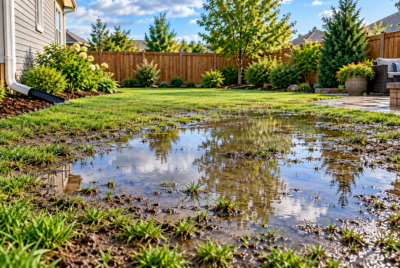
🕳️ 3. Your Yard Has Low Spots
If mud always develops in the same location, examine the shape of the ground.
Even a shallow depression can collect runoff from a surprisingly large area.
Low spots may develop because of:
- Soil Settling
- Removed Trees
- Construction
- Heavy Equipment
- Poor Original Grading
- Repeated Traffic
Water flows downhill and has nowhere else to go once it reaches that depression.
Smart Fix: Raise Minor Depressions
Small low spots may sometimes be corrected gradually with suitable topsoil.
Apply thin layers so existing grass isn’t buried.
Large depressions require more careful grading because changing the landscape can send water toward the house or neighboring property.
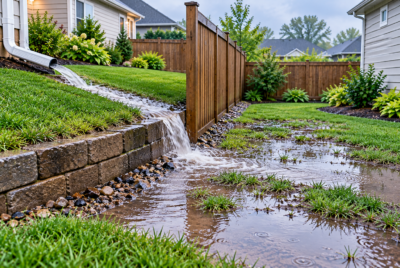
🏠 4. Your Downspouts Are Flooding The Backyard
Your roof collects a tremendous amount of water.
One inch of rainfall over 1,000 square feet of roof represents roughly 623 gallons of water before losses are considered.
Gutters collect that runoff and concentrate it into a handful of downspouts.
If a downspout empties directly into a poorly drained lawn, the area may become muddy after every significant storm.
Smart Fix: Redirect The Runoff
An inexpensive downspout extension may be enough.
Other situations may benefit from solid underground pipe, a rain garden, or another suitable drainage route.
Always make sure the new discharge location sends water away from your foundation without creating erosion or drainage problems for neighbors.
🌳 5. Too Much Shade Is Slowing Evaporation
Drainage isn’t the only factor determining how quickly a backyard dries.
Sunlight and airflow matter too.
Areas underneath mature trees, along north-facing walls, or between closely spaced buildings may receive little direct sunlight.
The ground loses moisture more slowly, while struggling grass leaves exposed soil vulnerable to mud.
Smart Fix
You probably don’t need to remove healthy mature trees simply to dry the lawn.
Instead, consider whether the area really needs to remain turf.
Shade-tolerant groundcovers, mulch, stepping stones, or appropriately selected plants may create a more practical landscape than repeatedly trying to establish grass in poor conditions.
🚿 6. You’re Watering Too Much
Sometimes the rain isn’t entirely responsible.
Automatic irrigation systems can keep soil constantly wet between storms.
This is particularly common with clay soil and shady lawns.
If sprinklers run on a fixed schedule regardless of weather, your lawn may receive water when it doesn’t need it.
Smart Fix: Water According To Conditions
Check soil moisture before irrigating.
Rain sensors and smart irrigation controllers can also help prevent unnecessary watering after storms.
Inspect sprinkler heads and underground lines for leaks if one particular section remains wetter than the rest of the lawn.
A mysterious muddy patch during dry weather deserves further investigation.
🛣️ 7. Your Patio Or Driveway Creates Extra Runoff
Roofs aren’t the only surfaces that shed water.
Concrete patios, driveways, walkways, sheds, and other impermeable surfaces prevent rainfall from soaking directly into the soil.
That water flows somewhere else.
If your patio slopes toward the lawn, hundreds of gallons of additional runoff may enter a relatively small area.
Smart Fix
Watch hard surfaces during rainfall and identify their discharge points.
Possible solutions include:
- Channel Drains
- Permeable Pavers
- Gravel Borders
- Rain Gardens
- Landscape Swales
- Better Surface Grading
Think about drainage before adding future patios, sheds, walkways, or other hardscape features.
🍃 8. Thick Thatch Or Weak Turf Is Making Things Worse
Thatch is the layer of living and dead plant material between the grass and soil.
A modest layer is normal, but excessive thatch may interfere with water movement and lawn health.
Weak or thin turf can also expose soil directly to rainfall and foot traffic, creating mud.
Do not automatically dethatch every soggy lawn.
Compaction underneath the grass is often the more important issue.
Smart Fix
Inspect both the turf and soil.
Depending on the problem, your lawn may benefit from aeration, appropriate dethatching, overseeding, compost topdressing, or changes in mowing and irrigation.
Healthy grass roots help build better soil structure over time.
🌊 9. Water Is Entering From Another Property
Water follows elevation, not fences.
If your backyard is lower than surrounding lots, runoff may naturally enter from a neighboring property.
This can become more noticeable after nearby construction or landscaping changes.
A new patio, retaining wall, shed, pool, or drainage system can alter how water moves.
Smart Fix
Observe the boundary during rain before assuming where the water originates.
A professionally designed swale or other landscape drainage feature may help intercept surface runoff.
Because stormwater regulations and property rights vary across the United States, avoid simply redirecting the problem back onto neighboring land.
💦 10. Your Water Table May Be High
Sometimes the moisture is coming from below rather than above.
A high water table can keep soil saturated even when surface drainage appears reasonable.
This may occur seasonally or be common in low-lying, coastal, lakeside, or wetland-adjacent areas.
One clue is a backyard that stays wet during extended dry weather or becomes saturated without much rainfall.
In this situation, compost and aeration alone probably won’t solve the entire problem.
Professional drainage evaluation may be needed.
🔍 How To Diagnose A Muddy Backyard Before Spending Money
If you’re still wondering why does my backyard stay muddy after rain, perform a simple backyard drainage inspection.
Start during the next safe rainfall.
Look for where water enters, how quickly it moves, and where it stops.
Then check the yard again several hours later and the following day.
Take photos of:
- Persistent Puddles
- Downspout Outlets
- Low Spots
- Patio Runoff
- Property Boundaries
- Muddy Paths
- Drainage Grates
Patterns often become obvious after two or three storms.
This observation costs nothing and may save hundreds or thousands of dollars by preventing unnecessary drainage work.
🛠️ Best Low-Cost Ways To Fix A Muddy Backyard
Start with the least expensive solution that addresses the source.
A practical order is:
- Reduce Extra Water: Adjust irrigation and repair leaks.
- Clean Gutters And Drains: Make sure existing drainage works.
- Extend Downspouts: Move roof runoff away from muddy sections.
- Core Aerate: Relieve soil compaction.
- Add Compost: Gradually improve soil structure.
- Correct Small Low Spots: Reduce localized pooling.
- Change Problem Areas: Replace struggling turf with suitable landscaping.
- Consider Drainage Systems: Evaluate swales, catch basins, or French drains only when needed.
The expensive option isn’t automatically the best option.
A $20–$40 downspout extension can sometimes outperform thousands of dollars of unnecessary landscape work because it removes the source of the problem.
🌿 Should You Install A French Drain?
French drains are popular solutions for wet yards, but they are not appropriate for every muddy lawn.
A typical French drain uses perforated pipe surrounded by drainage stone to collect and redirect subsurface water.
It may help where groundwater or water moving through saturated soil consistently affects one location.
But a French drain is usually unnecessary if the real cause is overwatering, a low spot, compacted soil, or roof runoff.
Most importantly, a drain needs a suitable place to discharge water.
Do not dig first and figure out the outlet later.
🌼 Turn A Problem Area Into A Better Outdoor Feature
Sometimes the smartest way to fix mud is to stop trying to make the area behave like a traditional lawn.
A chronically damp corner could potentially become:
- A Rain Garden
- A Native Planting Bed
- A Mulched Shade Garden
- A Gravel Path
- A Stepping-Stone Walkway
- A Moisture-Tolerant Landscape Area
Choosing plants suited to your USDA Hardiness Zone, sunlight, and soil conditions can reduce long-term maintenance.
You may end up with a backyard that looks more interesting while requiring less mowing and fewer repeated repairs.
👷 When To Consult A Professional
Consider calling a qualified landscaper, drainage contractor, irrigation specialist, or civil engineer when large areas remain saturated for days, water approaches your foundation, significant erosion occurs, or you suspect groundwater, septic, plumbing, or major grading problems.
Professional help is also smart before installing extensive underground drainage or dramatically changing your property’s grade.
Before digging, have underground utilities marked. In much of the United States, homeowners can contact 811 before excavation.
Also check local rules before redirecting stormwater.
❓ Frequently Asked Questions About Muddy Backyards
How Do I Fix A Backyard That Is Always Muddy?
Start by identifying where the excess water originates. Redirect downspouts, reduce irrigation, aerate compacted soil, add compost, and correct small low spots. Persistent problems may require a swale, catch basin, rain garden, or professionally designed drainage system.
Why Is My Backyard Muddy But My Front Yard Isn’t?
Your backyard may have heavier shade, poorer grading, more clay, greater compaction, or additional roof and patio runoff. Different parts of the same property can have very different drainage conditions.
How Can I Dry Up A Muddy Yard Fast?
Stop unnecessary irrigation and redirect obvious runoff first. Avoid driving or repeatedly walking across saturated soil because this increases compaction. Temporary drying doesn’t replace fixing the drainage problem that created the mud.
What Can I Put Over Mud In My Backyard?
Temporary options include wood chips, mulch, gravel, or stepping stones where appropriate. However, covering mud doesn’t solve excessive water. Correct the drainage source first, especially if standing water repeatedly develops.
Does Adding Topsoil Help A Muddy Yard?
Topsoil can help correct shallow depressions, but adding soil over a drainage problem may simply move the puddle somewhere else. Determine why the area is wet before changing the grade.
Will Gravel Help A Muddy Yard?
Gravel can create a firmer walking surface or play a role in a properly designed drainage feature. Simply dumping gravel into a muddy lawn, however, usually doesn’t fix the underlying drainage problem.
What Is The Cheapest Way To Fix A Muddy Backyard?
The cheapest solution for a muddy yard depends on the cause. Cleaning a blocked drain, reducing sprinkler use, adding a downspout extension, or aerating compacted soil can be inexpensive. Diagnose the water source before buying drainage materials.
📌 Conclusion: A Muddy Yard Doesn’t Have To Stay Muddy
If you’ve been asking, “Why does my backyard stay muddy after rain?” resist the urge to start digging immediately.
First, watch the water. Find out where it comes from, where it travels, and why it stops.
You may discover that the solution is as simple as extending a downspout, reducing irrigation, aerating compacted soil, or raising one small depression. And if part of the yard naturally wants to stay moist, turning it into a rain garden or attractive planting bed may make more sense than fighting nature year after year.
Smart yard improvement isn’t about spending the most money. It’s about solving the right problem.
Fix the water source, improve the soil where necessary, and design around the conditions you already have. You’ll spend less time dealing with mud and more time enjoying a cleaner, healthier, easier-to-maintain backyard.
That’s a smarter path to better yard living.
Disclaimer: This article provides general home and yard improvement information. Drainage regulations, soil conditions, stormwater requirements, utility locations, and landscaping rules vary by region. Follow appropriate DIY safety practices and consult qualified local professionals when necessary.
Explore more:
- How To Fix A Soggy Lawn That Never Seems To Dry Out
- How To Improve Drainage In Clay Soil
- Why Is Water Pooling Next To House After Rain?