
Why Is My French Drain Not Working? 9 Common Problems And How To Fix Them
When Your French Drain Stops Doing Its Job
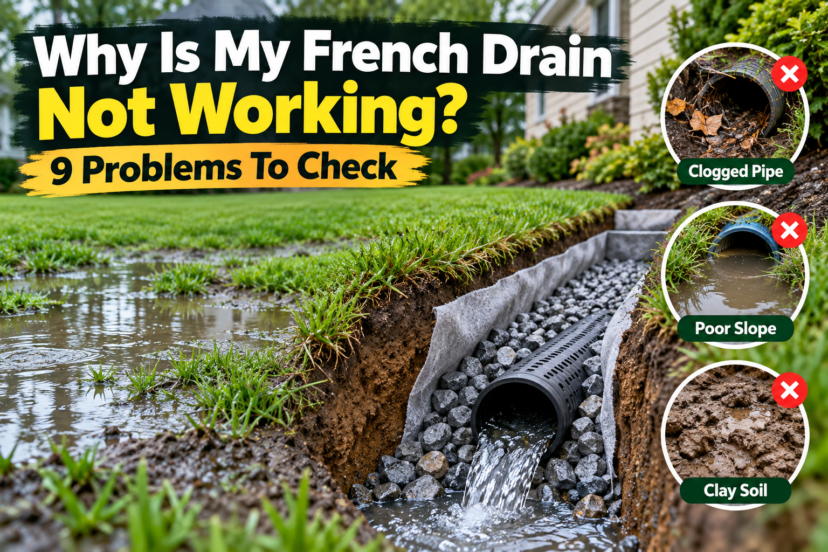
A French drain usually stops working because of soil and sediment clogging, improper slope or grading, tree root intrusion, or a blocked or crushed outlet. You installed a French drain to solve your soggy yard problem, but puddles are still forming after every heavy rain. Now you’re standing outside wondering, why is my French drain not working, and whether you wasted money on a drainage system that doesn’t actually help.
The good news is that a French drain that isn’t draining properly doesn’t always need to be replaced. Sometimes the problem is as simple as a blocked outlet, accumulated sediment, or water entering the system faster than it can escape.
Other times, the issue comes down to installation mistakes, poor grading, or soil conditions that prevent water from moving efficiently.
Understanding what went wrong can save you from unnecessary digging, expensive repairs, and repeated drainage problems.
In this guide, we’ll walk through nine common French drain problems, explain how to identify them, and show you practical ways to restore drainage while keeping your yard easier to maintain.
💧 Quick Answer: Why Is My French Drain Not Working?
If you’re asking why is my French drain not working, the most common causes include clogged pipes, blocked outlets, incorrect slope, compacted soil, and poor installation.
A French drain may also struggle when heavy rainfall overwhelms its capacity or when the surrounding soil doesn’t allow water to reach the drainage trench efficiently.
Start by inspecting the drain outlet, checking for standing water, and looking for signs of sediment buildup. Many minor problems can be corrected without replacing the entire drainage system.
Key Takeaways
-
Most Likely Cause: If you’re wondering why your French drain is not working, clogged outlets, sediment buildup, and installation problems are common explanations.
-
Usually Serious? Not always. Minor blockages may be easy to correct, but improper grading or damaged pipes can require professional repairs.
-
First Thing To Check: Inspect the discharge outlet and determine whether water has a clear, legal path away from the yard.
-
Best Solution: Identify the specific problem before digging. Cleaning, correcting drainage paths, or improving surface grading may restore performance without replacing the entire system.
🔍 1. Your French Drain Pipe Is Clogged With Sediment
One of the most common reasons a French drain stops working is sediment accumulation inside the perforated pipe.
Over time, fine soil particles can enter the drainage system and settle along the bottom of the pipe.
Eventually, the buildup restricts water movement.
Signs Of A Clogged French Drain
-
Water remains above the drainage trench after rainfall.
-
Drainage performance has gradually declined.
-
Muddy water appears at the outlet.
-
Water backs up near an accessible cleanout.
How To Fix It
If your system has a cleanout, a professional may be able to inspect the pipe with a drainage camera and remove sediment using appropriate cleaning equipment.
Avoid forcing a drain snake through thin corrugated piping, which can be damaged.
Smart Yard Tip: Accessible cleanouts make future maintenance easier and may reduce the need to excavate your lawn.
🚰 2. The French Drain Outlet Is Blocked
A French drain needs somewhere to discharge collected water.
If its outlet becomes blocked by leaves, soil, grass clippings, or debris, water can back up through the system.
This is often one of the easiest problems to investigate.
What To Check
Locate the discharge point, which may connect to a daylight outlet, catch basin, approved stormwater connection, or another permitted drainage feature.
Check whether debris is covering the opening.
If the outlet is accessible and safe to reach, remove loose debris and inspect for damage.
Make sure the discharge point hasn’t become buried under mulch or landscaping material.
Never open or enter underground drainage structures.
📐 3. Your French Drain Does Not Have Enough Slope
Water generally needs a suitable downhill path to move through a gravity-fed French drain.
If the pipe was installed too flat, or if sections slope backward, water may collect instead of flowing toward the outlet.
A commonly used installation target is approximately a 1% slope, or 1 inch of fall for every 100 inches of horizontal distance, although actual requirements depend on the design.
How To Identify The Problem
Look for standing water inside accessible cleanouts or low spots along the drain route.
A contractor can measure the pipe elevation using leveling equipment.
How To Fix It
Correcting the slope may require exposing and repositioning part of the pipe.
Before digging, confirm that the discharge destination is lower than the collection area.
Money-Saving Tip: Verify the elevation problem before replacing materials. Sometimes only one section needs adjustment.
🪨 4. The Gravel Or Filter Fabric Is Clogged
French drains rely on more than a perforated pipe.
The surrounding gravel creates spaces where water can move toward the pipe, while suitable filter fabric helps reduce soil migration.
However, poorly selected materials or incorrect installation can cause the system to clog.
For example, fine particles may gradually fill the spaces between gravel stones.
Some filter fabrics can also become clogged under certain soil and water conditions.
What You Can Do
If the pipe is clear but water still isn’t entering the trench, the surrounding drainage materials may be the problem.
A contractor may need to inspect a small section of the trench.
When rebuilding, use clean, appropriately sized drainage stone and filter materials selected for local soil conditions.
🌱 5. Compacted Or Clay Soil Is Slowing Water Movement
Heavy clay soil is another reason homeowners ask why their French drain isn’t working.
Clay contains very small particles and often allows water to move through it slowly.
Even when the pipe is functioning correctly, surrounding soil may prevent water from reaching the drain quickly enough.
This is especially common in yards with compacted ground, construction-disturbed soil, or persistent low spots.
How To Improve Drainage In Clay Soil
Consider combining your French drain with other practical improvements:
-
Redirect downspouts away from problem areas using an approved discharge route.
-
Improve surface grading where appropriate.
-
Reduce unnecessary foot and equipment traffic on wet soil.
-
Add suitable surface drainage for water that cannot infiltrate quickly.
A French drain is not always the best solution for surface puddles in dense clay.
Sometimes a shallow swale or properly installed catch basin works better.
🌊 6. Heavy Rainfall Is Overwhelming The Drainage System
Your French drain may work during light rain but struggle during major storms.
This doesn’t necessarily mean something is broken.
The drainage system may simply be receiving more water than it was designed to handle.
Heavy rainfall, concentrated roof runoff, and water flowing from higher ground can all increase the load.
What To Do
Observe where the water originates during a storm from a safe location.
If large amounts of surface runoff flow toward one area, consider whether grading improvements or additional surface drainage could reduce the pressure on the French drain.
Avoid automatically installing a larger pipe. The entire drainage path, including its outlet, must have adequate capacity.
🏡 7. The French Drain Was Installed In The Wrong Location
A French drain can be perfectly installed and still fail to solve your yard’s drainage problem.
Why?
Because it may not intercept the water causing the issue.
For example, a drain installed along one side of the lawn won’t necessarily help if runoff collects in a separate low area.
How To Check Drain Placement
After rainfall, observe:
-
Where water first begins accumulating.
-
Which direction surface water travels.
-
Whether the drain intercepts the wet area.
-
Whether nearby slopes direct water away from the trench.
The best location depends on whether you’re managing groundwater, shallow subsurface water, or surface runoff.
Better Yard Living Tip: Follow the water before choosing the solution. A simple grading correction may cost less than installing another underground drain.
🛠️ 8. The Drain Pipe Is Crushed, Damaged, Or Disconnected
French drain pipes can become damaged by heavy equipment, soil movement, roots, or poor installation.
Flexible corrugated pipes may also develop low spots or become deformed if they lack proper support.
A damaged pipe can restrict drainage or allow water to escape where it shouldn’t.
How To Fix A Damaged Pipe
A drainage camera inspection can help locate damaged sections without digging up the entire yard.
Once the problem is identified, the affected section may be excavated and replaced.
Choose piping appropriate for the burial depth, expected loads, and drainage application.
Avoid driving heavy equipment over shallow drainage trenches unless they were designed for that load.
🌿 9. Your Yard’s Surface Grading Is Still Wrong
A French drain cannot compensate for every grading problem.
If your lawn slopes toward your foundation or contains deep depressions, rainwater may continue collecting on the surface.
This can happen even when the underground drainage system works properly.
How To Improve Surface Drainage
Start by identifying low spots and areas where water flows toward structures.
Depending on your yard, practical improvements may include:
-
Filling minor lawn depressions with suitable soil.
-
Creating a gentle surface swale.
-
Redirecting roof runoff to an approved location.
-
Improving grading away from the house.
Keeping soil and mulch below siding and required foundation clearances.
For substantial grading work, consult a professional to avoid creating new drainage problems.
🔧 How To Troubleshoot A French Drain Without Digging Up Your Yard
Before paying for major repairs, work through a few basic checks.
French Drain Troubleshooting Checklist
These observations can help you explain the problem to a contractor and avoid paying for unnecessary work.
💰 How To Prevent Future French Drain Problems
Preventive maintenance is usually easier than repairing a failed underground system.
Inspect accessible outlets several times a year, especially after heavy storms or major landscaping work.
Keep leaves, grass clippings, and mulch away from discharge openings.
Make sure downspouts aren’t directing unexpected amounts of water into a drainage system that wasn’t designed for roof runoff.
Also, avoid planting large trees directly over drainage lines where roots may eventually interfere.
A little seasonal attention can help protect your landscaping investment and keep your outdoor spaces usable.
👷 When To Consult A Professional
Contact a qualified drainage contractor, landscaper, or appropriate foundation specialist when water repeatedly reaches your foundation, the pipe appears damaged, or the drain requires major excavation.
Professional help is also worthwhile when you cannot identify the outlet, suspect incorrect grading, or need to redesign the system.
If water is entering your basement or causing structural concerns, address the problem promptly.
❓ Frequently Asked Questions About French Drains Not Working
1. Why Is My French Drain Not Working After Heavy Rain?
Heavy rainfall may exceed the system’s capacity, especially when large amounts of surface runoff enter the drainage area. A blocked or submerged outlet can also cause water to back up.
2. How Do I Know If My French Drain Is Clogged?
Common signs include reduced drainage performance, persistent wet areas, and sediment near accessible outlets. A drainage camera inspection can help confirm a blockage.
3. Can A French Drain Stop Working Over Time?
Yes. Sediment buildup, clogged gravel, root intrusion, pipe damage, and changes in surrounding landscaping can gradually reduce drainage performance.
4. How Long Should A French Drain Last?
A properly designed and installed French drain may function for decades, but its lifespan varies with soil conditions, materials, installation quality, and maintenance.
5. Can You Unclog A French Drain Without Digging?
Sometimes. Accessible pipes may be cleaned through a cleanout using suitable equipment. However, clogged surrounding gravel or damaged pipe sections may require excavation.
6. Why Is Water Still Standing Above My French Drain?
Water may not be reaching the trench efficiently, the outlet may be blocked, or surface runoff may exceed the system’s capacity. Poor grading can also leave puddles above a functioning drain.
7. Should Water Always Come Out Of A French Drain Outlet?
No. A French drain may not discharge visible water during dry weather or light rainfall. Water flow depends on soil moisture, groundwater levels, rainfall, and the drainage system’s design.
🌻 Conclusion: Restore Your Drainage And Enjoy A Better Yard
If you’ve been wondering why is my French drain not working, remember that a drainage problem doesn’t automatically mean you need an entirely new system.
A blocked outlet, sediment buildup, poor slope, or incorrect placement may explain the issue.
Start with simple inspections, identify where water is coming from, and make targeted improvements before committing to expensive excavation.
A smarter drainage system helps protect your landscaping, reduces muddy areas, and makes your yard more comfortable after rainfall.
Better yard living starts with solving the right problem—not spending more money than necessary.
Disclaimer: This article provides general home improvement information. Before digging, contact 811 or your local utility-location service, follow applicable drainage and stormwater regulations, and consult a qualified professional for major drainage, grading, or foundation concerns.
Explore more:

Comments are closed.