
French Drain Vs Catch Basin: Which Is Better For Your Yard?
A wet yard can quickly turn a relaxing outdoor space into a muddy maintenance problem. But before digging trenches or buying drainage pipe, you need to choose the right system for the type of water you’re dealing with. The French drain vs catch basin decision usually comes down to one simple question: Is the problem water moving across the surface, or water saturating the soil?
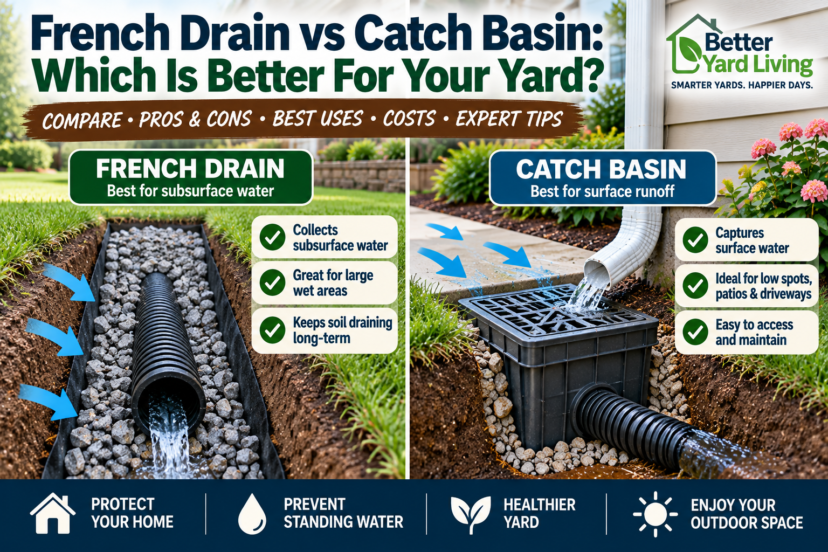
French drains and catch basins can both move unwanted water, but they collect it differently. A catch basin is designed mainly to capture concentrated surface runoff, while a French drain collects water from saturated soil along a longer underground path.
Choosing correctly can save you considerable digging, materials, and frustration.
In this guide, we’ll compare how each system works, where each performs best, typical installation considerations, maintenance, and when combining both systems may create the smartest drainage solution for your yard.
💧 Quick Answer: French Drain Vs Catch Basin
In the French drain vs catch basin comparison, a catch basin is generally better for collecting concentrated surface water from a low spot, patio, driveway, or downspout area. A French drain is generally better for intercepting water moving through saturated soil across a larger area. Some yards benefit from both: catch basins collect surface runoff while French drains manage subsurface moisture.
Key Takeaways
Most likely cause: Yard drainage problems usually result from concentrated surface runoff, poorly draining saturated soil, low spots, improper grading, or a combination of these conditions.
Usually serious? Not always, but repeated standing water can damage turf, cause erosion, create muddy areas, and become more concerning when water collects near a foundation.
First thing to check: Observe your yard during rainfall to determine whether water flows across the surface or slowly appears through saturated soil.
Best solution: In the French drain vs catch basin decision, use a catch basin for concentrated surface water and consider a French drain for persistent subsurface drainage problems.
🌧️ What Is The Difference Between A French Drain And Catch Basin?
Both systems collect unwanted water and move it somewhere else, but their collection methods are very different.
What Is A French Drain?
A French drain is a gravel-filled trench that typically contains perforated drainage pipe.
Water enters through the gravel and flows into the perforated pipe. The pipe then carries it toward a suitable outlet.
Because water can enter along much of the trench, a French drain can intercept moisture across a relatively long section of saturated ground.
Think of it as an underground drainage corridor.
What Is A Catch Basin?
A catch basin is a box installed at a low point with a grate at or near ground level.
Surface water flows through the grate and enters the basin. A solid drainage pipe then carries the collected water to an appropriate discharge point.
Think of it as a drain for a specific collection point.
This basic distinction makes choosing between a French drain vs catch basin much easier.
⚖️ French Drain Vs Catch Basin At A Glance
| Feature | French Drain | Catch Basin |
|---|---|---|
| Best For | Subsurface water | Surface runoff |
| Collection Area | Long trench | Specific low point |
| Typical Pipe | Perforated | Solid |
| Gravel Required | Usually yes | Usually around installation, depending on design |
| Handles Patio Runoff | Not usually first choice | Yes |
| Helps Saturated Soil | Yes | Limited |
| Captures Debris | Limited | Basin can trap some debris |
| Maintenance Access | More difficult | Easier |
| Installation Effort | Moderate to high | Low to moderate |
| Needs An Outlet | Yes | Yes |
Neither drainage system is automatically better. The right one depends on how water behaves in your yard.
🕳️ When A Catch Basin Is Better
A catch basin works best when you can clearly see water flowing toward one location.
For example, imagine a patio that slopes toward the lawn.
During a storm, water rushes across the concrete and creates a large puddle where the patio meets the grass.
That is a classic surface-water problem.
Installing a catch basin at the collection point can intercept the runoff before it spreads across the lawn.
Catch Basins Are Often Useful For:
- Low Spots In Lawns
- Patio Runoff
- Driveway Runoff
- Downspout Discharge Areas
- Pool Deck Drainage
- Landscape Courtyards
- Areas With Visible Surface Flow
The basin should sit at the natural low point so gravity brings water toward the grate.
From there, solid pipe moves it toward a suitable outlet.
🌊 When A French Drain Is Better
Now imagine a different situation.
Your lawn doesn’t necessarily develop one large puddle. Instead, a 30-foot strip stays soggy for days after rainfall.
When you walk across it, the ground feels soft and saturated.
That may indicate water moving through or accumulating within the soil.
This is where a French drain may be more appropriate.
French Drains Can Help With:
- Long Soggy Sections Of Lawn
- Subsurface Water Movement
- Saturated Soil Along Slopes
- Seepage From Higher Ground
- Certain Foundation Drainage Problems
- Water Moving Through Soil From Neighboring Higher Ground
Because water can enter the trench along its length, a French drain doesn’t depend on runoff reaching one small grate.
That’s its biggest advantage in the French drain vs catch basin comparison.
🏡 Which Is Better For Standing Water?
It depends on why the standing water exists.
If rainwater visibly flows across the surface and settles in one low spot, a catch basin may be the simpler solution.
If the entire area remains saturated because water is moving slowly through heavy soil, a French drain may work better.
But don’t overlook an even simpler possibility.
A standing-water problem could be caused by:
- A Short Downspout
- A Clogged Gutter
- Excessive Irrigation
- A Broken Sprinkler Line
- A Blocked Existing Drain
- Poor Surface Grading
Correct these issues before installing a new underground system.
You may discover that you don’t need either drain.
🧱 Which Is Better For Clay Soil?
Heavy clay creates a special challenge because water moves through it slowly.
A French drain may help intercept subsurface water in certain clay-heavy yards, but it doesn’t magically make all surrounding clay soil drain quickly.
Likewise, a catch basin can remove water that reaches its grate but cannot pull moisture from a large saturated lawn.
Before choosing either system, consider improving the conditions contributing to the problem.
Core aeration and compost topdressing can gradually improve the structure of compacted lawn soil. Redirecting roof runoff can reduce the amount of water the clay must absorb.
For severely saturated clay sites, professional drainage planning may be worthwhile.
💰 French Drain Vs Catch Basin Cost Considerations
Installation cost varies significantly based on trench length, depth, pipe size, soil, landscaping, disposal requirements, accessibility, and local labor rates.
In general, a single catch basin connected to an existing or straightforward drainage route can require less excavation than a long French drain.
French drains usually involve:
- Digging A Long Trench
- Removing Soil
- Installing Geotextile Where Appropriate
- Adding Drainage Stone
- Installing Perforated Pipe
- Adding More Stone
- Restoring The Surface
A catch basin generally requires excavation around one collection point plus a trench for the outlet pipe.
However, don’t choose based on price alone.
A cheaper drainage system that doesn’t address the actual problem isn’t a bargain.
Correct diagnosis usually saves more money than simply selecting the least expensive product.
🛠️ How French Drain Installation Works
Although designs vary, a typical French drain begins with a sloped trench.
A drainage design may incorporate geotextile to help separate surrounding soil from the drainage stone. Perforated pipe is placed within the stone-filled trench and routed toward an appropriate outlet.
Water enters the stone, reaches the pipe, and travels downhill.
The exact depth, pipe orientation, slope, stone, and fabric arrangement depend on the site and drainage objective.
One of the biggest DIY mistakes is building a beautiful trench without planning where the water will ultimately go.
Every drainage system needs a destination.
🔧 How Catch Basin Installation Works
Catch basin installation is conceptually simpler.
First, identify the low point where surface water naturally collects.
The basin is installed so the grate can receive runoff without becoming a trip or mowing hazard.
A solid pipe connects to the basin and carries water downhill.
Possible discharge options may include a legal stormwater connection, daylight outlet, infiltration area, or another locally permitted solution.
Catch basins need accessible grates because debris can collect inside.
Grass clippings, leaves, mulch, and soil should be removed periodically so the basin continues functioning.
🔄 Can You Connect A Catch Basin To A French Drain?
Yes, drainage systems can sometimes combine different components, but the design needs to make sense hydraulically.
For example, a yard may have both:
- Surface Runoff From A Patio
- Saturated Soil Along A Slope
A catch basin could collect concentrated patio runoff while a separate or integrated drainage design addresses subsurface moisture.
However, simply connecting every drain on the property to one pipe isn’t always wise.
The downstream pipe and outlet must be capable of handling the combined water volume.
If not, the system may back up during heavy storms.
This is one reason larger drainage projects benefit from professional planning.
🍂 Which System Requires More Maintenance?
Catch basins generally require more frequent visible maintenance because the grate collects surface debris.
Fortunately, access is easy.
Periodically inspect for:
- Leaves
- Grass Clippings
- Mulch
- Soil
- Trash
- Sediment
French drains have fewer exposed components but can be more difficult to service if sediment or roots eventually reduce performance.
Proper construction is therefore especially important.
Keeping sediment-heavy surface runoff out of a French drain can help extend its useful life.
📍 Where Should The Water Go?
This is arguably more important than the French drain vs catch basin question.
Collecting water is only half the job.
The system needs to release that water somewhere safe and legal.
Depending on the property and local regulations, that might be:
- A Suitable Daylight Outlet
- A Stormwater System
- A Designed Infiltration Area
- A Rain Garden
- Another Approved Drainage Location
Never assume you can discharge stormwater into the street, sanitary sewer, or neighboring property.
Municipal rules vary significantly across the United States.
Also avoid creating an erosion problem at the pipe outlet. Concentrated drainage water can wash away soil quickly unless the discharge area is designed appropriately.
🌱 When Neither Drain Is The Best Solution
Sometimes the smartest French drain vs catch basin decision is choosing neither.
- If your problem is mostly surface runoff, a shallow landscape swale might be simpler.
- If a downspout creates the puddle, extending it could solve the problem for a fraction of the cost.
- If one lawn depression holds water, correcting the grade might work.
Other options include:
- Rain Gardens
- Downspout Extensions
- Core Aeration
- Compost Topdressing
- Permeable Pavers
- Channel Drains
- Improved Grading
- Native Moisture-Tolerant Landscaping
Good drainage isn’t about installing the most impressive system. It’s about using the simplest solution that reliably addresses the cause.
🔍 How To Choose The Right Drainage Solution
Before buying anything, observe your yard during a moderate-to-heavy rainstorm from a safe location.
Ask four questions:
- Where Is The Water Coming From? Roof, patio, hill, driveway, neighboring land, or saturated soil?
- How Is It Moving? Across the surface or through the ground?
- Where Does It Collect? One specific depression or a large saturated area?
- Where Can It Safely Go? Every drainage solution needs an acceptable destination.
- If you see water rushing toward one low point, investigate a catch basin.
- If water appears throughout a long saturated strip, investigate subsurface drainage such as a French drain.
- If a downspout is dumping directly into the problem area, fix that first.
This simple observation can prevent a lot of unnecessary digging.
🌿 Benefits Of Choosing The Right Yard Drainage System
Making the right French drain vs catch basin choice can improve much more than drainage.
Potential benefits include:
- Less Standing Water
- Fewer Muddy Areas
- Healthier Turf
- Reduced Soil Erosion
- Easier Mowing
- Cleaner Walkways
- More Usable Outdoor Space
- Better Protection Around The Home
Most importantly, your yard becomes easier to live with.
Instead of avoiding half the lawn for several days after every storm, you can spend more time using the outdoor space you already own.
👷 When To Consult A Professional
Consider hiring a qualified drainage contractor, landscaper, civil engineer, or foundation professional if large portions of the yard remain saturated, water repeatedly collects against your foundation, erosion is severe, or you suspect groundwater or major grading problems.
Professional help is also smart when several drainage systems must be connected or when there is no obvious gravity outlet.
Before digging, have underground utilities marked. In much of the U.S., homeowners can contact 811 before excavation.
Check local stormwater and permit requirements as well.
❓ FAQs About French Drains And Catch Basins
Is A Catch Basin Better Than A French Drain?
Neither is universally better. A catch basin is typically better for concentrated surface runoff, while a French drain is often better for intercepting subsurface water along a larger area.
Can A Catch Basin Drain A Soggy Yard?
A catch basin can remove surface water that flows toward its grate. It won’t necessarily dry a broad area of saturated soil if the water is primarily underground.
Can A French Drain Handle Heavy Rain?
A properly designed French drain can manage substantial subsurface water, but its capacity depends on trench design, pipe size, slope, soil conditions, and outlet capacity. It shouldn’t automatically be used as the main collector for large volumes of concentrated surface runoff.
How Deep Should A French Drain Be In A Yard?
There isn’t one correct depth for every French drain. Depth depends on where the water is moving, the site’s slope, landscaping, outlet elevation, and purpose of the system. Diagnose the drainage problem before choosing trench depth.
Where Should A Catch Basin Drain To?
A catch basin should discharge to a safe and locally permitted location such as an approved stormwater system, suitable daylight outlet, or designed infiltration area. Local rules determine which options are allowed.
Do Catch Basins Get Clogged?
Yes. Leaves, grass, mulch, soil, and sediment can accumulate inside the basin or grate. Regular inspection and cleaning help keep the system working.
Can I Install A French Drain And Catch Basin Myself?
Some straightforward residential projects can be DIY-friendly for experienced homeowners, but correct slope, outlet planning, utility locations, soil conditions, and stormwater regulations matter. Complex drainage or foundation-related problems are better evaluated professionally.
🌤️ Conclusion: Choose The Drain That Matches The Water
The smartest way to settle the French drain vs catch basin debate is to stop thinking about the drain first and start thinking about the water.
Watch what happens during a storm.
If runoff travels across your patio or lawn and gathers in one obvious low point, a catch basin may be the practical choice.
If a long section of ground remains saturated because water is moving through the soil, a French drain may make more sense.
And if the real culprit is a short downspout, clogged gutter, low spot, or excessive irrigation, you may not need either one.
That’s the key to smarter yard improvement: diagnose first and spend second.
Choose the simplest system that solves the actual problem, give the water a safe destination, and you’ll be on your way to a drier, healthier, easier-to-maintain outdoor space.
That’s better yard living.
Disclaimer: This article provides general yard improvement information. Drainage design, soil conditions, utility locations, permits, stormwater rules, and building requirements vary by location. Follow appropriate DIY safety procedures and consult qualified local professionals when necessary.
Explore more:
- How To Fix A Soggy Lawn That Never Seems To Dry Out?
- Why Does My Backyard Stay Muddy After Rain?
- How To Divert Rainwater Away From House And Yard?

Comments are closed.