Why Is My Yard Still Wet Days After Rain? 10 Common Causes And Smart Fixes
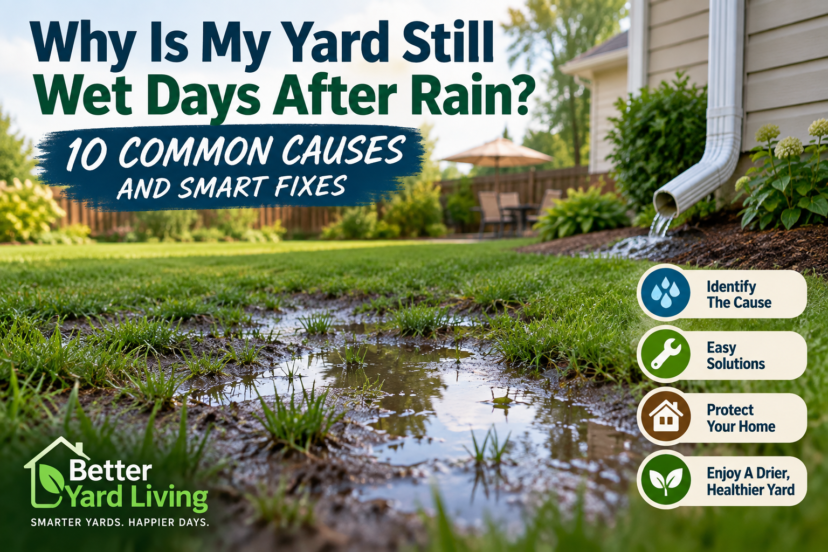
A rainstorm should give your lawn and plants a healthy drink—not turn your backyard into a soggy mess for the rest of the week. If you’re asking, why is my yard still wet days after rain, the problem usually comes down to drainage, soil conditions, grading, or water being directed toward the wrong part of your property.
A consistently wet yard can make mowing difficult, create muddy footprints, damage grass, attract mosquitoes, and make patios and play areas less enjoyable. More importantly, persistent standing water near your home may eventually contribute to foundation, crawl space, or basement moisture problems.
Fortunately, a wet lawn doesn’t automatically mean you need an expensive drainage system. Many problems can be improved with simple changes to gutters, soil, landscaping, and water flow.
Here’s how to identify what’s keeping your yard wet—and choose the smartest solution without wasting money.
💧 Quick Answer: Why Is My Yard Still Wet Days After Rain?
If you’re wondering why is my yard still wet days after rain, the most common reasons are compacted soil, heavy clay, poor grading, low spots, excessive roof runoff, blocked drainage systems, or a high water table. Start by watching where water collects during the next storm. Simple solutions such as aerating the lawn, extending downspouts, filling low areas, or improving soil structure may solve the problem before major drainage work is needed.
Key Takeaways
Most likely cause: Poor drainage caused by compacted soil, clay-heavy soil, low spots, improper grading, or concentrated roof runoff.
Usually serious? Not always. Occasional soggy soil after heavy rain is normal, but water that remains for several days or repeatedly collects near your foundation deserves attention.
First thing to check: After a storm, identify exactly where water collects and check whether gutters, downspouts, neighboring properties, slopes, or hard surfaces are sending extra water there.
Best solution: The right fix depends on the source. Aeration, soil improvement, downspout extensions, regrading, rain gardens, swales, and French drains are common options when solving why is my yard still wet days after rain.
🌧️ 10 Common Reasons Your Yard Stays Wet After Rain
Before installing drains or bringing in heavy equipment, determine where the excess water is coming from. Fixing the actual cause is usually cheaper and more effective than simply trying to remove the symptoms.
1. Your Soil Is Heavily Compacted
Compacted soil is one of the most common reasons a lawn stays soggy.
Foot traffic, lawn equipment, construction activity, vehicles, and even years of normal use can compress soil particles together. This reduces the air spaces that normally allow rainwater to soak into the ground.
Instead of infiltrating quickly, water sits on the surface.
A simple test is to push a screwdriver several inches into moist soil. If it’s surprisingly difficult, compaction may be part of the problem.
Smart fix: Core aeration can create openings that help water, oxygen, and nutrients move into the root zone. Heavily used lawns may benefit from periodic aeration, particularly where traffic is concentrated.
2. You Have Heavy Clay Soil
Clay isn’t necessarily bad soil. It can hold nutrients and moisture well. The problem is that its extremely fine particles can drain slowly, especially when the soil becomes compacted.
This is common in many parts of the United States.
After prolonged rain, clay soil may become saturated and stay wet long after sandy or loamy soil has drained.
Smart fix: Improve soil gradually with organic matter such as quality compost. Avoid trying to “fix” clay by mixing small amounts of sand into it, which can sometimes create an even denser soil structure.
3. Your Yard Has Low Spots
Does the same patch of lawn become a miniature pond after every storm?
You may simply have a depression in the landscape.
Water naturally moves downhill and collects at the lowest point available. Even a relatively small change in elevation can direct runoff into one part of your lawn.
Low spots can develop from:
- Soil settling
- Construction activity
- Removed trees
- Heavy equipment
- Poor original grading
- Repeated foot or vehicle traffic
Smart fix: Shallow depressions may sometimes be corrected by gradually adding suitable topsoil and restoring the lawn. Larger grading problems require more careful planning so you don’t accidentally redirect water toward your house or a neighboring property.
4. Your Yard Slopes Toward The House
A yard should generally direct surface runoff away from the home’s foundation rather than toward it.
If the soil has settled or the property was poorly graded, rainwater may move toward the house and collect nearby.
This deserves more attention than a random soggy patch at the back of the property because persistent moisture near a foundation may contribute to basement or crawl space moisture problems.
Smart fix: Minor grading issues may be corrected by adjusting soil elevations near the home while maintaining proper clearance below siding and other building materials. Significant grading problems are usually better evaluated professionally.
🏠 5. Your Downspouts Are Dumping Too Much Water Into The Lawn
Your roof collects a surprisingly large amount of rain.
For perspective, 1 inch of rain falling on 1,000 square feet of roof represents roughly 623 gallons of water before accounting for losses. If several downspouts discharge into one poorly drained area, the lawn can quickly become saturated.
This is one of the first things to investigate when asking why is my yard still wet days after rain.
Look at your downspouts during a storm.
Are they dumping water beside the foundation? Into a flower bed? Onto an already soggy section of lawn?
Smart fix: Downspout extensions can move water farther from the house to a safe discharge area. An underground solid drainpipe may also be appropriate, provided it has a suitable outlet and complies with local requirements.
Never redirect runoff onto neighboring property.
6. Your Gutters Or Drainage Pipes Are Blocked
Sometimes the drainage design is fine—the system simply isn’t working.
Leaves, roofing debris, soil, roots, mulch, and other material can clog gutters, downspouts, catch basins, channel drains, and underground drainage pipes.
Water then overflows or backs up into areas that normally remain dry.
Check for:
- Overflowing gutters
- Slow-draining catch basins
- Buried outlets
- Standing water around downspouts
- Debris-filled grates
- Damaged drainpipe
Cleaning an existing system can be far cheaper than installing a new one.
7. Too Much Of Your Property Is Covered With Hard Surfaces
Driveways, sidewalks, patios, roofs, and other hard surfaces prevent rainwater from soaking naturally into the soil.
Instead, they create runoff.
As more homes add patios, outdoor kitchens, sheds, walkways, and entertainment areas, homeowners sometimes unintentionally send significantly more water toward their lawns.
Smart fix: Observe where water leaves these surfaces. Permeable pavers, gravel areas, rain gardens, strategic planting beds, and properly designed drainage channels can sometimes help manage runoff while improving the appearance and usefulness of your yard.
🌱 8. Your Lawn Has A Thick Thatch Or Poor Root Zone
A struggling lawn can sometimes contribute to drainage problems.
Thatch is the layer of living and dead plant material between grass blades and the soil surface. A moderate layer is normal, but excessive buildup may interfere with water movement.
Poor soil underneath the turf can create similar problems.
Before automatically dethatching, inspect the lawn. Many homeowners assume thatch is responsible when compacted soil underneath is actually the bigger issue.
Smart fix: Improve the entire root zone rather than focusing only on the surface. Aeration, appropriate fertilization, proper mowing, compost topdressing, and suitable grass selection can help build healthier soil over time.
9. Groundwater Is Naturally Close To The Surface
Sometimes the problem isn’t rainwater coming from above.
A naturally high water table can keep soil saturated from below, particularly in low-lying areas and properties near wetlands, lakes, rivers, coastal zones, or poorly drained soils.
One clue is that the yard remains unusually wet even after several dry days.
Another is that multiple nearby properties experience similar conditions.
A French drain or other drainage system may help in certain situations, but groundwater problems can be more complicated than ordinary surface runoff.
10. Water Is Entering From A Neighboring Property
Water doesn’t pay attention to property lines.
If neighboring land sits higher than yours, runoff may naturally move onto your property. New construction, patios, retaining walls, landscaping, pools, or drainage changes can sometimes alter established water patterns as well.
Before assuming your neighbor caused the problem, observe the area during rainfall.
Determine whether the water is actually entering from another property or simply collecting in a low area on yours.
Local rules concerning stormwater and drainage vary, so significant disputes or drainage changes may require professional guidance.
🔍 How To Find Out Why Your Yard Stays Wet
You don’t need to become a drainage expert. You simply need to become a good observer.
The best time to diagnose a wet yard is during and immediately after rainfall.
Walk around your property safely and look for where the water originates, how it moves, and where it stops.
Pay particular attention to:
- Downspout discharge points
- Patio and driveway runoff
- Low areas
- Property boundaries
- Drainage grates
- Slopes around the house
- Water near foundations
- Areas where puddles repeatedly form
Take photos during several storms. These can reveal patterns that are difficult to recognize once the water disappears.
You can also mark persistent puddles with small landscape flags and see how long each location takes to drain.
🛠️ Best Ways To Fix A Yard That Stays Wet After Rain
The smartest drainage solution is usually the simplest option that addresses the actual source of the water.
Don’t install a French drain automatically because your lawn feels soggy.
Start With Low-Cost Solutions
Try straightforward improvements first when appropriate:
- Clean Gutters And Drainage Grates
- Extend Downspouts
- Core Aerate Compacted Lawn
- Improve Soil With Compost
- Correct Small Depressions
- Reduce Unnecessary Irrigation
- Keep Drainage Outlets Clear
These changes can cost far less than excavation and may solve the problem completely.
Consider A Rain Garden
A rain garden can turn a naturally wet section of your landscape into an attractive feature.
These shallow planted areas temporarily collect runoff and allow water to soak into the ground gradually. Plants are selected to tolerate periods of both moisture and dryness.
A properly located rain garden may also reduce mowing while adding flowers, wildlife habitat, and visual interest.
However, rain gardens need suitable soil, placement, and separation from structures and utilities.
Create A Landscape Swale
A swale is a shallow, gently sloped channel designed to move or manage runoff.
Unlike a concrete drainage ditch, a residential swale can often blend naturally into landscaping and may be covered with grass, stone, or suitable vegetation.
Swales can be particularly useful when surface water follows a predictable path across the property.
Install A French Drain When Appropriate
A French drain typically uses perforated pipe surrounded by drainage stone to collect subsurface water and redirect it toward an appropriate outlet.
It can work well for certain consistently soggy areas. But it isn’t a universal solution.
A French drain needs somewhere for the collected water to go. Installing one without proper slope, pipe, aggregate, filtration, or discharge planning can result in an expensive trench that accomplishes very little.
💡 How To Prevent A Wet Yard From Coming Back
Once you’ve solved why is my yard still wet days after rain, focus on preventing the problem from returning.
Think of your yard as a complete water-management system. Your roof, gutters, lawn, garden beds, patio, driveway, soil, and property slope all interact.
A smarter long-term approach includes maintaining gutters, keeping drainage outlets clear, preventing soil compaction, monitoring low areas, and checking drainage whenever you build a new patio, shed, walkway, or landscape feature.
Also avoid watering automatically after significant rainfall. A rain sensor or smart irrigation controller can help prevent unnecessary watering when the soil already contains plenty of moisture.
A healthy yard doesn’t need to be perfectly dry. It simply needs to handle normal rainfall without creating persistent puddles, mud, or moisture problems around your home.
👷 When To Consult A Professional
Consider calling a landscaper, drainage contractor, civil engineer, foundation professional, or other qualified specialist when water repeatedly pools against your foundation, large areas remain saturated for days, erosion is occurring, you suspect a high water table, or the project requires major excavation or grading.
Professional help is also worthwhile when you’re uncertain where drainage water can legally discharge.
Before digging, always have underground utilities located through the appropriate service in your area—often 811 in the United States.
❓ Frequently Asked Questions
How Long Should A Yard Stay Wet After Rain?
There isn’t one universal timeframe because soil type, rainfall amount, temperature, slope, vegetation, and groundwater conditions all matter. However, persistent puddles that remain for several days after ordinary rainfall can indicate poor drainage, compacted soil, grading problems, or saturated ground.
Why Is My Yard Soggy When It Hasn’t Rained Recently?
Possible causes include overwatering, leaking irrigation lines, plumbing leaks, high groundwater, septic system problems, or water entering from neighboring land. If one area remains wet during extended dry weather, investigate further rather than assuming rainfall is responsible.
How Can I Dry Out A Soggy Yard Fast?
First, stop unnecessary irrigation and redirect obvious sources such as downspouts. Temporary surface water may sometimes be moved safely, but the long-term solution is correcting the cause through better grading, aeration, soil improvement, drainage, or runoff management.
Does Aerating A Lawn Help With Drainage?
Yes, core aeration can improve water infiltration when soil compaction contributes to poor drainage. However, aeration won’t correct major grading problems, high groundwater, or large volumes of runoff being directed into the yard.
Will Adding Topsoil Fix A Wet Yard?
Adding suitable soil can help correct small low spots, but simply covering a drainage problem isn’t always effective. Before adding topsoil, determine why water collects there and make sure changes won’t redirect runoff toward your home or neighboring properties.
What Is The Best Drainage System For A Wet Yard?
There is no single best system. Downspout extensions may solve roof runoff, swales can manage surface water, French drains may collect subsurface water, and rain gardens can temporarily capture suitable runoff. The best solution depends on where the water originates and where it can safely go.
Can A Wet Yard Damage My House?
A soggy lawn far from the house may simply be inconvenient. Persistent water near the foundation is more concerning because excess moisture can contribute to basement or crawl space dampness, soil movement, erosion, and other property problems. Correct drainage around the home promptly.
🌿 Conclusion: Build A Yard That Works With Water, Not Against It
If you’ve been wondering why is my yard still wet days after rain, don’t assume the solution requires thousands of dollars in drainage work.
Start with observation. Find where the water comes from. Watch where it travels. Identify where it collects. Then fix the simplest cause first.
Sometimes that means cleaning a clogged drain or adding a downspout extension. Other yards may benefit from aeration, better soil, corrected grading, a rain garden, swale, or professionally designed drainage system.
The goal isn’t simply a drier lawn. It’s creating an outdoor space that requires less maintenance, protects your home, costs less to manage, and gives you more time to actually enjoy your yard.
That’s what better yard living is all about.
Disclaimer: This article provides general home and yard improvement information. Drainage requirements, stormwater rules, permits, soil conditions, and utility locations vary by region. Use appropriate DIY safety practices and consult qualified local professionals when necessary.
 Explore more:
- Outdoor Extension Cord Not Working After Rain?
- Energy Efficient Backyard: 12 Smart Ways
- Best Backyard Shade Ideas: 12 Smart Ways